Cocoa goes up. Three desserts are now wrong.
Use recipes as ingredients in other recipes. When a sub-recipe's cost changes, every parent recipe updates automatically.
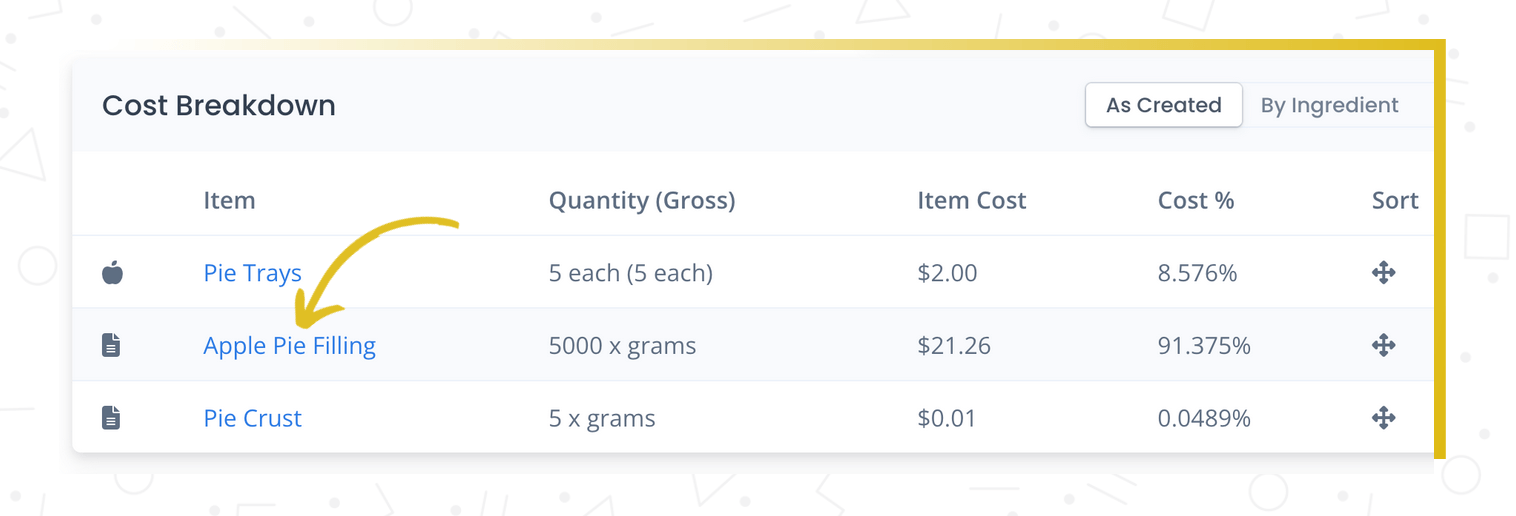
Cascading cost errors multiply silently
Your ganache costs $4.20. It goes into three desserts. Cocoa prices rise. You recalculate the ganache — but forget to update one dessert. That recipe runs on wrong margins for weeks.
- Manually recalculating when a component cost changes
- Forgetting to update all parent recipes
- Duplicating ingredient lists instead of using shared components
Make any recipe a sub-recipe. When it changes, every recipe that uses it updates automatically.
A lot of what you make goes into something else. Your pizza dough is an ingredient in your pizza. Your BBQ sauce goes into six different dishes. Your ganache is a component of three desserts.
In Recipe Cost Calculator, any recipe can be used as an ingredient in another recipe. The cost, nutrition data, and allergen information from the sub-recipe all flow through to the parent automatically. Change the sub-recipe and every parent that uses it updates.
What you get
Recipes inside recipes
Use any recipe as an ingredient. Cost, nutrition, and allergens all flow through.
Automatic cost updates
Sub-recipe cost changes cascade to every parent recipe instantly.
Build with building blocks
Cost your sauces, doughs, and bases once. Use them as components everywhere.
How it works
Create component recipes
Cost your sauces, dressings, doughs, and bases as standalone recipes.
Use them as ingredients
Add sub-recipes as ingredients in final recipes. Specify the amount used.
Everything flows through
Costs, nutrition, and allergens from sub-recipes cascade into every parent recipe.
Sub-recipes vs. duplicated ingredient lists
| The old way | With RCC |
|---|---|
| Copy all 8 BBQ sauce ingredients into every recipe | Add 'BBQ Sauce' as a single sub-recipe ingredient |
| Cocoa price up — manually find and update every recipe | Cocoa up — ganache and all parent recipes update automatically |
| No clear cost for prep items like sauces and doughs | Every component costed as its own recipe with full visibility |
This is really useful for operations that do a lot of batch prep. You cost your sauces, dressings, doughs, and bases as their own recipes, then use them as building blocks. The parent recipe shows the true cost including every component — no manual adding things up.
Sub-recipes can go multiple levels deep if needed. A base recipe can be part of a sub-recipe that's part of a final product. The cost chain stays intact all the way through.
Why this matters
Build recipes from recipes.
When your components are properly costed as sub-recipes, you always know the true cost of the final product — and when a component price changes, every dish that uses it updates automatically. No more manually recalculating cascading cost changes.
Frequently asked questions
Build recipes from recipes
Sub-recipes keep your costs accurate and your recipe structure clean.